
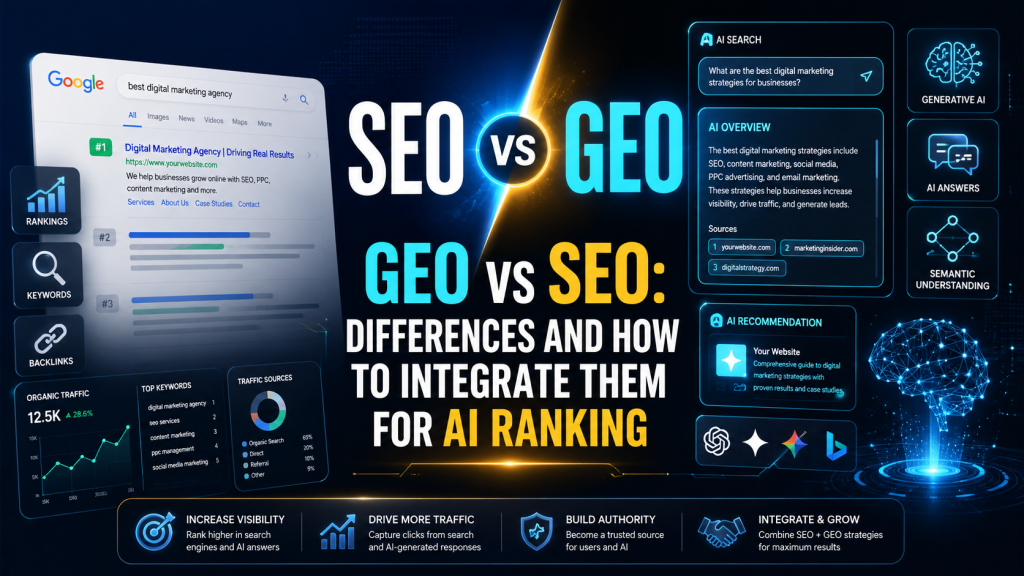
Do GEO and SEO compete or complement each other? In practice, GEO and SEO work together: SEO allows your content to be visible in search engines, while GEO aims to have that same content used in AI-generated answers.
Why should you understand the relationship between SEO and GEO ? Because search behavior is changing, and optimizing only for search engines no longer covers all the touchpoints where users find information and, therefore, your brand.
GEO and SEO: Definition of both concepts
Let’s start by defining each one:
- SEO (Search Engine Optimization): refers to organic ranking in search engines like Google or Bing. Its goal is to improve a website’s visibility in unpaid search results through technical optimization, relevant content, and authority (links).
- GEO (Generative Engine Optimization): This refers to positioning within generative search engines or AI systems, such as ChatGPT, Gemini, or Copilot. Its goal is for content to be selected, cited, or used as a source in AI-generated responses.
Note: In Jacksonville, finding a GEO agency without SEO expertise isn’t feasible; after all, without a solid technical foundation (SEO), achieving real results is difficult. In this context, it’s preferable to look for both GEO and SEO agencies , such as DSA Web Design.
GEO V SEO key differences
We have already started with the definition of both concepts, where some differences can be noted. But these are not the only ones. In the following table, we can see more clearly what differentiates both strategies:
| Criterion | SEO (Search Engine Optimization) | GEO (Generative Engine Optimization) |
| Aim | To position a website in the top organic search engine results. | To get the content used or cited in AI-generated responses. |
| Example: Appearing in Google’s top 3 for “buy laptops in Peru”. | Example: being quoted in a ChatGPT response about “best laptops for studying”. | |
| Metrics | Organic traffic, CTR, SERP positions, bounce rate, conversions. | Mentions in AI responses, brand visibility, indirect traffic, subject authority. |
| Example: moving from position 10 to 3 and increasing visits from Google. | Example: an AI mentioning your brand as a reference in several responses. | |
| Type of result | Link list (SERP) with snippets. | Direct answers generated by AI, sometimes with cited sources. |
| Example: See a list of pages when searching for “what is SEO”. | Example: receiving a complete answer without leaving the chat. | |
| Content structure | Optimized for crawling and indexing (H1, H2, metadata, URLs, internal linking). | Clear, direct, and organized to facilitate information extraction by AI. |
| Example: Use of H2 headings with keywords. | Example: clear definitions at the beginning and well-ordered lists. | |
| Content style | Focused on keywords and resolving search intent. | Focused on answering questions accurately, contextually, and completely. |
| Example: strategically repeating “digital marketing in Peru”. | Example: answer directly “what is digital marketing” in the first paragraph. | |
| Content format | Articles, landing pages, optimized blogs, evergreen content. | Structured content: answers, lists, definitions, FAQs. |
| Example: 1500-word article optimized for one keyword. | Example: Frequently asked questions section with clear and concise answers. | |
| Classification factors | Search engine algorithms (relevance, authority, links, user experience). | Not entirely public; they prioritize quality, clarity, authority, and context. |
| Example: acquiring backlinks to improve domain authority. | Example: clear content that an AI can easily interpret and reuse. | |
| Use of keywords | Fundamental: guides content optimization. | Important, but more flexible; it prioritizes intention and natural language. |
| Example: optimize for “SEO agency in Lima”. | Example: Include natural variations such as “web positioning in Lima”. |
Can GEO and SEO be integrated?
Yes. In fact, GEO needs a solid SEO structure. If a website wants to appear in AI-generated answers but lacks a proper technical foundation, quality content, and authority, it will hardly be considered a reliable source.
These tips can help you:
- Analyze your current state and correct deficiencies: identify technical SEO errors (indexing, speed, structure) and implement structured data to facilitate content understanding.
- Leave generic content behind: what you publish must provide real value. Whenever possible, back up your information with reliable sources.
- Demonstrate your subject authority: you can do this through blog posts, author profile optimization, case studies, and research that includes expert opinions in your field.
- Pay attention to the content structure: organize the information with both users and AI systems in mind. Keywords are still important, but they should be integrated naturally.
- Get reviews and participate in relevant spaces: user opinions and participation in forums or communities provide signals of trust and relevance.
Ready to appear in AI search results? Contact our SEO and GEO specialists in Jacksonville!